

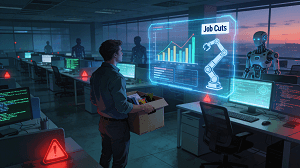
 Three years ago, I felt far more positive about artificial intelligence and its ability to create new jobs. Back then, it was easier to believe AI would mostly help workers, not replace them. Today, that optimism is gone.
The more I talk with executives about how they’re rolling out AI, the more worried I become for everyday workers in the US. Yes, top performers will use AI tools to unlock huge productivity gains and advance their careers. But what happens to the solid, reliable employees who aren’t “rock stars,” or to older workers who can’t quickly adapt to AI-driven workflows?
Too often, they end up spending a year searching for work or switching to gig jobs like driving for Uber (UBER). Even that path looks shaky: Uber is pushing ahead with Rivian (RIVN) robotaxis to compete with Tesla’s autonomous vehicles, which could eventually reduce the need for human drivers.
At an event this week at the Economic Club of New York, Circle (CRCL) co-founder and CEO Jeremy Allaire warned that by 2027, Wall Street’s focus on cost-cutting will be intense, and that shift will show up in how companies use AI. He expects investors to quickly spot which firms are truly optimizing with AI and which are falling behind. In his view, the labor market will feel that pressure in the near term.
We are already seeing signs of this. Major layoffs at Block (XYZ), Amazon (AMZN), and potentially soon at Meta (META) show how companies are restructuring as they invest more aggressively in AI. A recent Morgan Stanley survey of employers in five sectors most exposed to AI found a 4% net reduction in jobs. The group hit hardest: early-career workers and those with no prior experience, whose roles are being eliminated and not replaced.
Some of the most telling comments I heard about AI this week
Circle CEO Jeremy Allaire
Allaire believes “agentic” AI will radically speed up economic activity and make corporations far more efficient. In his view, AI can transform productivity and GDP growth across almost every major industry.
He also thinks AI agents will replace a very large share of the work currently done by humans, especially in white-collar jobs. That’s the message he gives his own employees: if they embrace AI agents, they gain new “superpowers” and can have much bigger impact. If they don’t, they risk being left behind.
IBM Vice Chairman Gary Cohn
Gary Cohn takes a more historical view. He argues that displaced workers will be retrained and will find other roles, just as they have during past technology shifts—like when cars replaced horse-drawn carriages. There’s always fear that a new technology will wreck society, he says, but big economic growth can create better opportunities.
Cohn points out that we still need skilled tradespeople: AI can’t fix a sink, rewire a house, or install new lighting. Demand for plumbers, carpenters, and electricians is already high and could rise further. With the massive buildout of data centers and power infrastructure, those projects will be done by people, not machines. To him, the key is training enough human hands to do this work.
HP Inc. Board Member Songyee Yoon
Songyee Yoon sees AI creating many new kinds of jobs that will require human attention, talent, and intelligence. She doesn’t deny that change will be disruptive, though. The transition won’t happen smoothly or automatically.
She stresses that society needs to focus on upskilling—giving workers the training they need to move into AI-era roles rather than leaving them to navigate the shift alone.
Edward Jones CEO Penny Pennington
Penny Pennington breaks AI’s impact into three categories: automation of tasks, augmentation of human work, and the addition of entirely new opportunities. In her view, AI won’t replace everything; instead, it will change the mix of what people do.
She argues that our real edge is becoming better at being human. Creativity, judgment, ethics, integrity, discernment, and taste are the qualities that will matter most. Leaders, she says, must focus on developing those uniquely human skills so their people can thrive alongside AI, not be replaced by it.